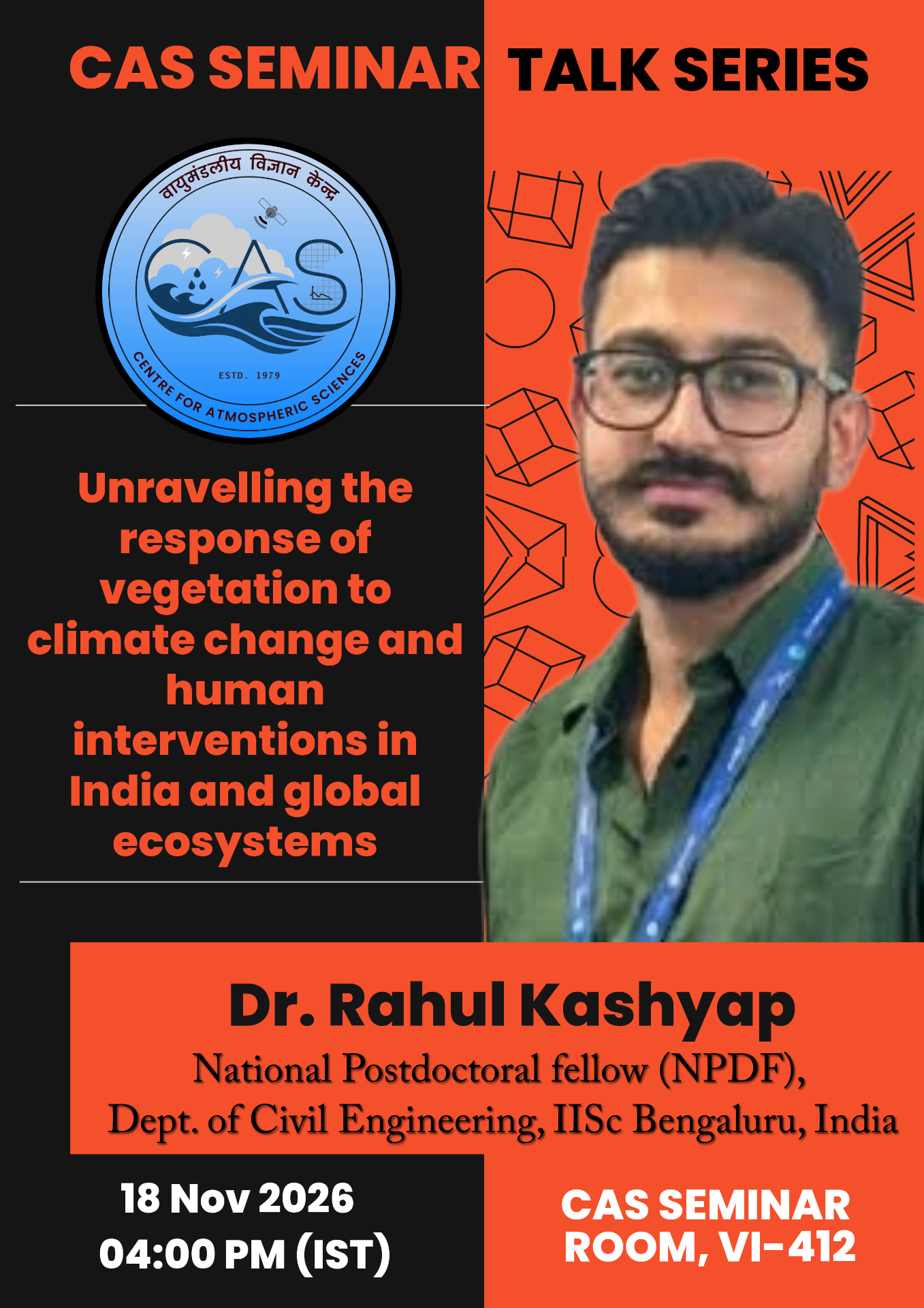
Guest Seminar by Dr. Rahul Kashyap, National Postdoctoral fellow (NPDF), Department of Civil Engineering, Indian Institute of Science (IISc), Bengaluru, India
Speaker: Dr. Rahul Kashyap, National Postdoctoral fellow (NPDF), Department of Civil Engineering, Indian Institute of Science (IISc), Bengaluru, India
Date and time: Nov 18, 2026 at 4:00 pm
Venue: CAS Seminar Room (VI-412)
Title: Unravelling the response of vegetation to climate change and human interventions in India and global ecosystems
Abstract: The land–atmosphere interaction is crucial to the climate and earth system through the exchange of energy, water, momentum and carbon among biosphere and atmosphere. In recent times, a great deal of variability in anthropogenic land use along with climate variability has greatly altered the terrestrial biosphere all around the globe. India is the second largest contributor to global greening and lies in the tropical and sub-tropical region of higher carbon uptake and is also one of the global hotspots of land-atmosphere interactions. Additionally, India is an extensively agrarian economy that depends largely on its croplands and forest resources. However, there remains uncertainty regarding the response of the terrestrial ecosystems to climate change and human interventions as vegetation-climate-human interactions is very intricate. Therefore, satellite-based earth observation, reanalyses and climate projection data, ecosystem models and a suite of statistical and machine learning techniques are utilised for better process-based understanding of the various mechanisms at play in the vegetation dynamics and associated carbon-water cycle relationships at India and global scales.
India has been greening in the past two decades. The magnitude of greening in croplands is twice the forests. The two key mechanisms that control vegetation dynamics in India are (i) warming-induced moisture stress; leading to browning (e.g., South India, Northeast India) and (ii) the moisture-induced greening (e.g., West, Indo-Gangetic Plains and central India). Soil moisture (SM) exhibits direct causal relationships with Carbon Use Efficiency (CUE) and its determinants. SM is the primary driver of both CUE and Water Use Efficiency (WUE) for Indian vegetated lands. Indian forests exhibit hindered translation of the structure (greenness) into functioning (carbon uptake) recent decades due to reduction in translation factor i.e., Ecosystem Photosynthetic Efficiency (EPE), This decline in EPE is predominant in the pristine forests of eastern Himalaya and Western Ghats due to enhanced moisture stress, rising aridity and increased wildfires, in the warming climate. Ecological droughts are rising in most parts (except western) of India due to enhanced land evaporative, meteorological and atmospheric aridity. The rising ecological droughts driven by enhanced aridity and ocean warming leads to browning during summer monsoon, which is a concern for sustainability, food security and climate change mitigation.
Temperature is the dominant driver of global photosynthesis, followed by soil moisture. Across biomes and land cover types, moisture availability is the key climatic control in tropical and arid but temperature in temperate and cold biomes. However, there is decline in the control of temperature on photosynthesis due to saturation of boreal warming-induced greening and increasing dryness stress. The influence of water availability and energy has substantially grown on global photosynthesis. Therefore, the global photosynthesis is largely driven by moisture ahead of warmth and energy in the drying world. Greening continues in sparse canopy, but slowdown/reversal for dense canopy due to rising moisture stress in current and future climate scenarios. In moisture-stressed ecosystems, gain in resilience facilitates photosynthesis and decline in resilience results in slowdown or reversal of greening. This calls for effective land management to enhance the resilience of vulnerable ecosystems to rising moisture stress for ensuring food security and sustainability.
Keywords: Land-Atmosphere Interactions; Vegetation Dynamics; Carbon Cycle; Water Cycle; Climate Change; Remote Sensing; Machine Learning; Food Security; Sustainability
Bio: Dr. Kashyap has background in geospatial technology with Integrated Master of Technology (M.Tech) in Geoinformatics at the Department of Geoinformatics, Central University of Jharkhand, India during 2016–2021. This was followed by PhD in Earth System Science as a Prime Minister’s Research Fellow (PMRF) at Centre for Ocean, River, Atmosphere and Land Sciences (CORAL), Indian Institute of Technology Kharagpur (IIT-KGP), India during 2021–2025. His PhD thesis is titled as "Response of Terrestrial Vegetation to regional and global Climate Change: implications for Carbon-Water-Human nexus and Food Security”.
Next, he had a brief tenure as a research associate at the Centre for Climate Change Research (CCCR), Indian Institute of Tropical Meteorology (IITM), Ministry of Earth Sciences (MoES), Government of India, working on land-atmosphere interactions and extreme events in South Asia. Next, he joined as Institute Postdoctoral fellow (IPDF) and very recently as National Postdoctoral fellow (NPDF), at the Department of Civil Engineering, Indian Institute of Science (IISc) working in the domain of carbon-water relations in India based on remote sensing and machine learning.
He largely employs satellite-based earth observation, reanalyses and climate projection data and a suite of statistical and machine learning techniques that includes regression and tree based algorithms and causal inference to explore the complex vegetation-climate-human interactions. The domains of his research interest are Land-Atmosphere Interactions, Vegetation Dynamics, Vegetation-Climate Interactions, Ecohydrology, Carbon Dynamics, Food Security, Land Cover Dynamics, Extreme Events, Biodiversity and GHGs. He has authored 20 journal publications with 16 of them as lead author, and 3 book chapters, 2 as lead author. He has published as lead author in journals like Journal of Cleaner Production, Resources Conservation and Recycling, Communications Earth and Environment, npj Climate and Atmospheric Science, Science of The Total Environment, Journal of Environmental Management, Applied Geography, GIScience & Remote Sensing, and others. He has also very actively participated in international and national conferences with 28 presentations as oral talks/posters including multiple American Geophysical Union (AGUs) and European Geosciences Union (EGUs) meetings.
He has participated in the Global Youth Climate Summit 2021, and also designated as Climate Advocate at FXB Climate Advocate Spring 2022, USA. He has also participated in international training programmes including the Oxford Climate School (2021) and Cornell University’s Carbon Cycle Modelling workshop (2024). Additionally, he serves in the editorial board of Frontiers in Remote Sensing journal and reviewer for over 30 journals such as Nature Communications, Global Change Biology, ISPRS Journal of Photogrammetry and Remote Sensing, Journal of Cleaner Production, Communications Earth and Environment, Ecological Indicators, Carbon Balance Management, Agricultural and Forest Meteorology and others. He has also been member of various societies including AGU, EGU, FLUXNET Early Career Network, New Phytologist, Oxford Climate Society, IEEE Geoscience and Remote Sensing Society, AsiaFlux, Indian Society of Remote Sensing, Indian Society of Geomatics, Indian Meteorological Society and GIS Academia Council of India (invited).