Gross primary production variations dominate the response of Indian terrestrial carbon fluxes to global climatic phenomena
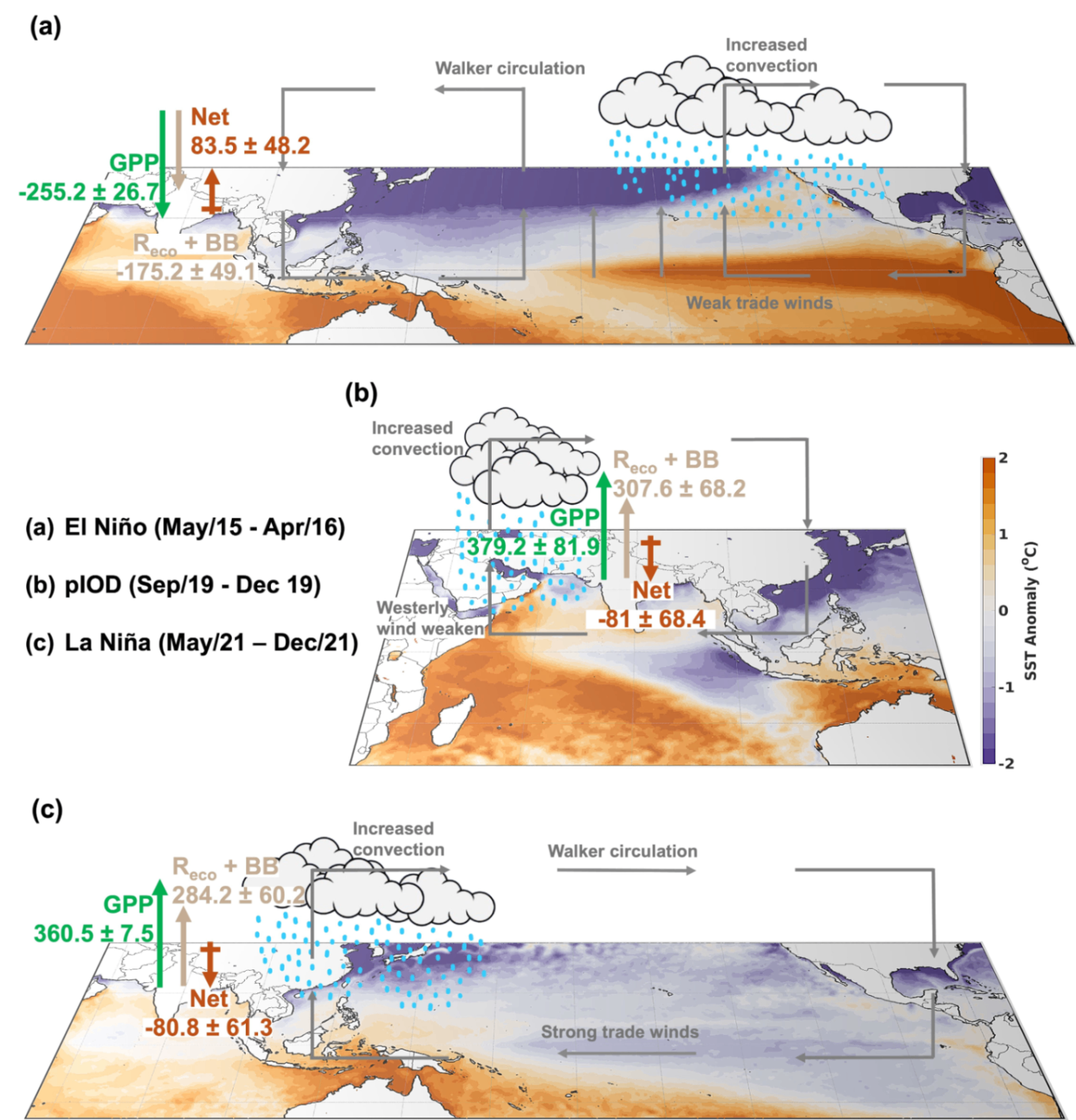
A better understanding of country-scale anthropogenic carbon dioxide emissions and natural flux estimates and the carbon-climate feedback, is critical in formulating national climate policies to attain net zero emissions. Here, we use the atmospheric carbon dioxide column observations from the Orbiting Carbon Observatory-2 satellite to unravel the response of the Indian land biosphere to global climatic phenomena such as El Niño-Southern Oscillation and Indian Ocean Dipole. An ensemble of global flux inverse models constrained by satellite observations indicates a reduction in carbon uptake by the Indian land biosphere during El Niño and an enhanced uptake during La Niña and positive Indian Ocean Dipole events. We find that the large Gross Primary Production variations, as compared to total ecosystem respiration, determined the response of flux variability to climatic phenomena. The carbon-climate constraints imposed by satellite observations over India help elucidate how biospheric uptake may offset anthropogenic emissions in the future.
Journal Name: Communications Earth and Environment (Nature Portfolio Journal)
Authors: Emili Singha Roy, Sajeev Philip, Matthew S. Johnson, David F. Baker, Junjie Liu, Sourish Basu, Frederic Chevallier, Fei Jiang, Xing Li, Zhiqiang Liu, Scot M. Miller, Jingfeng Xiao, and Ning Zeng
Published article is available online
Faculty Associated
Prof. Sajeev Philip