Aerosol-Cloud Interactions and Their Role in Modulating Lightning Activity: Evidence from Extreme Events Over India
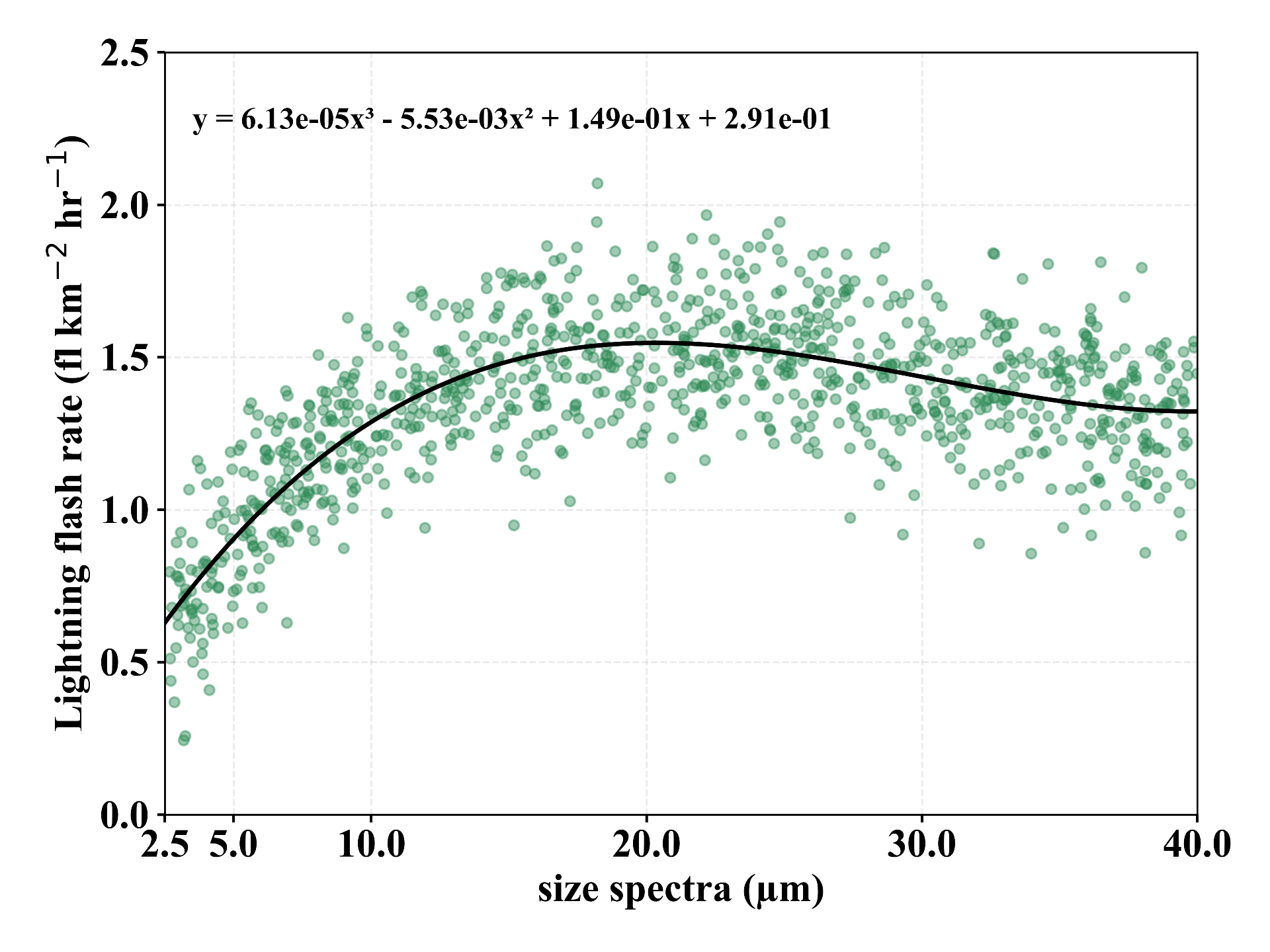
Lightning activity across the Indian subcontinent has exhibited a sharp rise in recent years, with significant implications for public safety, especially under a warming climate. This study examines the role of aerosol–cloud interactions in modulating lightning flash rates using the Weather Research and Forecasting (WRF) model for two intense pre-monsoon lightning events over distinct climatological regions in India: west-central India (16 April 2019) and northeast India (6 May 2013). Simulations were conducted using three aerosol-aware microphysics schemes, Morrison, National Severe Storms Laboratory (NSSL), and Fast Spectral Bin Microphysics (FSBM), in combination with various boundary layer and cumulus schemes. The FSBM–Yonsei University–Grell-3D configuration yielded the best agreement with observations, minimizing errors in temperature, planetary boundary layer height, and lightning flash rate. Sensitivity experiments revealed a nonlinear relationship between cloud condensation nuclei (CCN) concentrations and lightning activity: flash rate increased with aerosol loading up to an optimal CCN value (~7500 cm⁻3 in west-central India and ~3000 cm⁻3 in northeast India) beyond which lightning activity declined. A similar threshold behavior was observed with aerosol size, where coarse-mode particles enhanced lightning rates, but giant aerosols (≥30 µm) led to suppression. These effects were linked to changes in updraft intensity, water vapor content, and graupel formation, key factors influencing charge separation. The results show the importance of region-specific meteorological conditions in governing the response of lightning to aerosol perturbations and highlight the need to incorporate such nonlinearities into predictive frameworks.
Journal Name: JGR: Atmosphere
Authors: Subhojit Ghoshal Chowdhury, Dilip Ganguly, Aman Waheed Khan and Sagnik Dey
Published article is available online
Faculty Associated
Prof. Dilip Ganguly, Prof. Sagnik Dey