Mesoscale Convective Systems over South Asia: Unraveling climatology, land-ocean differences and environmental drivers
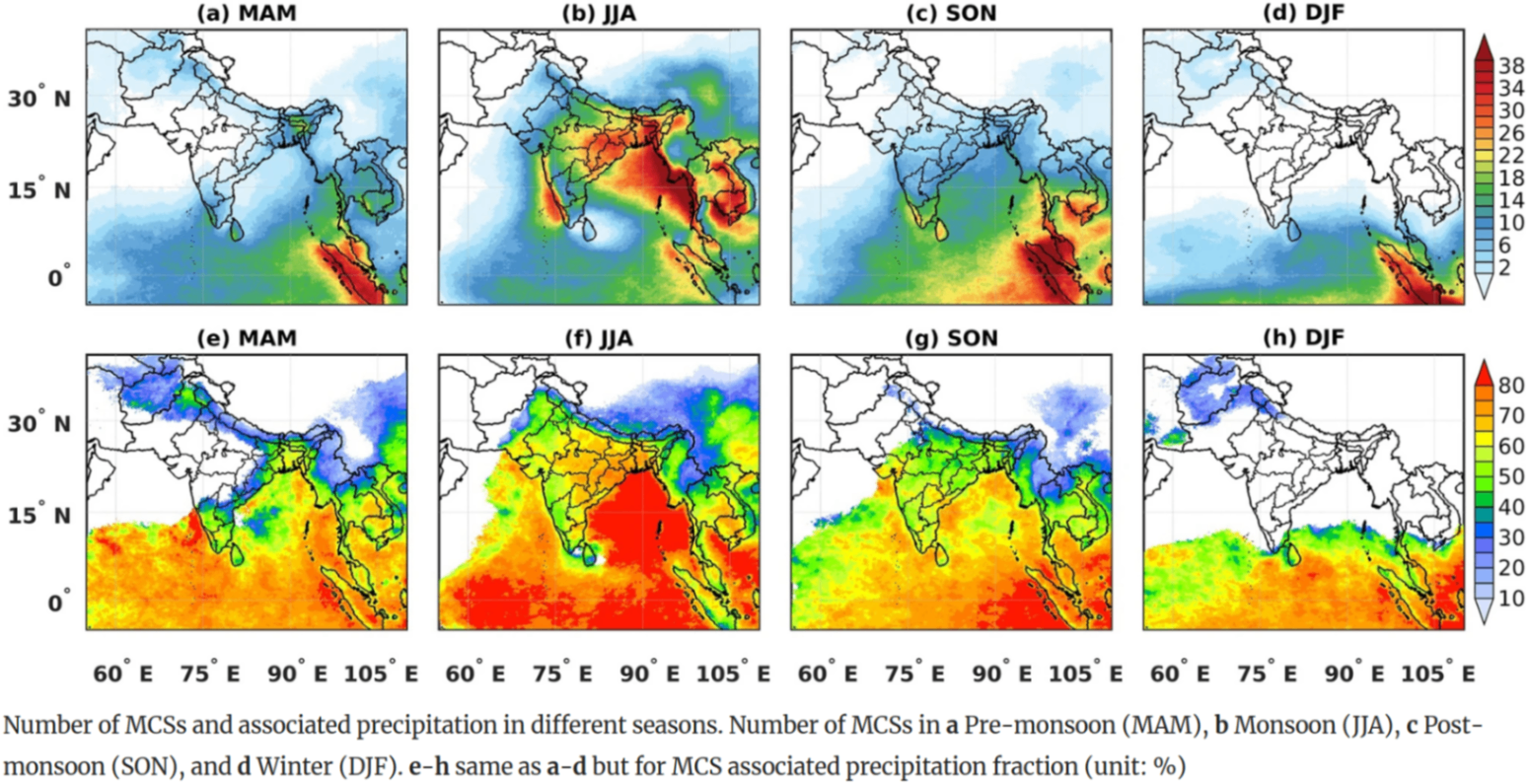
Mesoscale convective systems (MCSs) play important role in global and regional precipitation and are often associated with extreme weather events. However, studies over South Asia are limited due to the lack of long-term, high-resolution MCS data. We have developed and investigated a two-decade (2001-2020) long database of MCSs in South Asia. Our results highlight multiple MCS hotspots, including the eastern Bay of Bengal and adjacent regions of Myanmar, Western Ghats, eastern, north-eastern, and southern peninsular India, equatorial Indian Ocean, Sri Lanka, Maldives, along with maritime continents and other parts of Southeast Asia. These regions receive more than 50% of their annual mean rainfall from the MCSs, with significant seasonal variability. The highest number of systems form during the monsoon season. Although a higher number of systems form over oceans, land and coastal systems contribute more to the seasonality. The oceanic systems are larger, longer lived and vertically deeper. Interestingly, super MCSs only occur over the Bay of Bengal during the monsoon. The land (ocean) receives 46-49% (57-67%) of their annual mean precipitation from MCS. Extreme rainfall (80-100 mm/hr) is predominantly produced by MCS. The movement of MCSs depends on the relative role of the mean cloud layer wind, low-level jet, and the cold pools. We also find that over land, instability, moisture convergence, and vertical ascent increase markedly within six hours before MCS genesis, while wind shear decreases. Over ocean, the build-up begins earlier and is more dynamically driven. In contrast, terrestrial MCSs are thermodynamically triggered. These differing precursors offer valuable cues for MCS prediction.
Journal Name: Climate Dynamics
Authors: Debjit Paul, Sarvesh Dubey, and Wenjun Cui
Published article is available online
Faculty Associated
Prof. Sarvesh Dubey