Characterizing the South Asian summer monsoon in the Model for Prediction Across Scales through quasi uniform and variable resolution
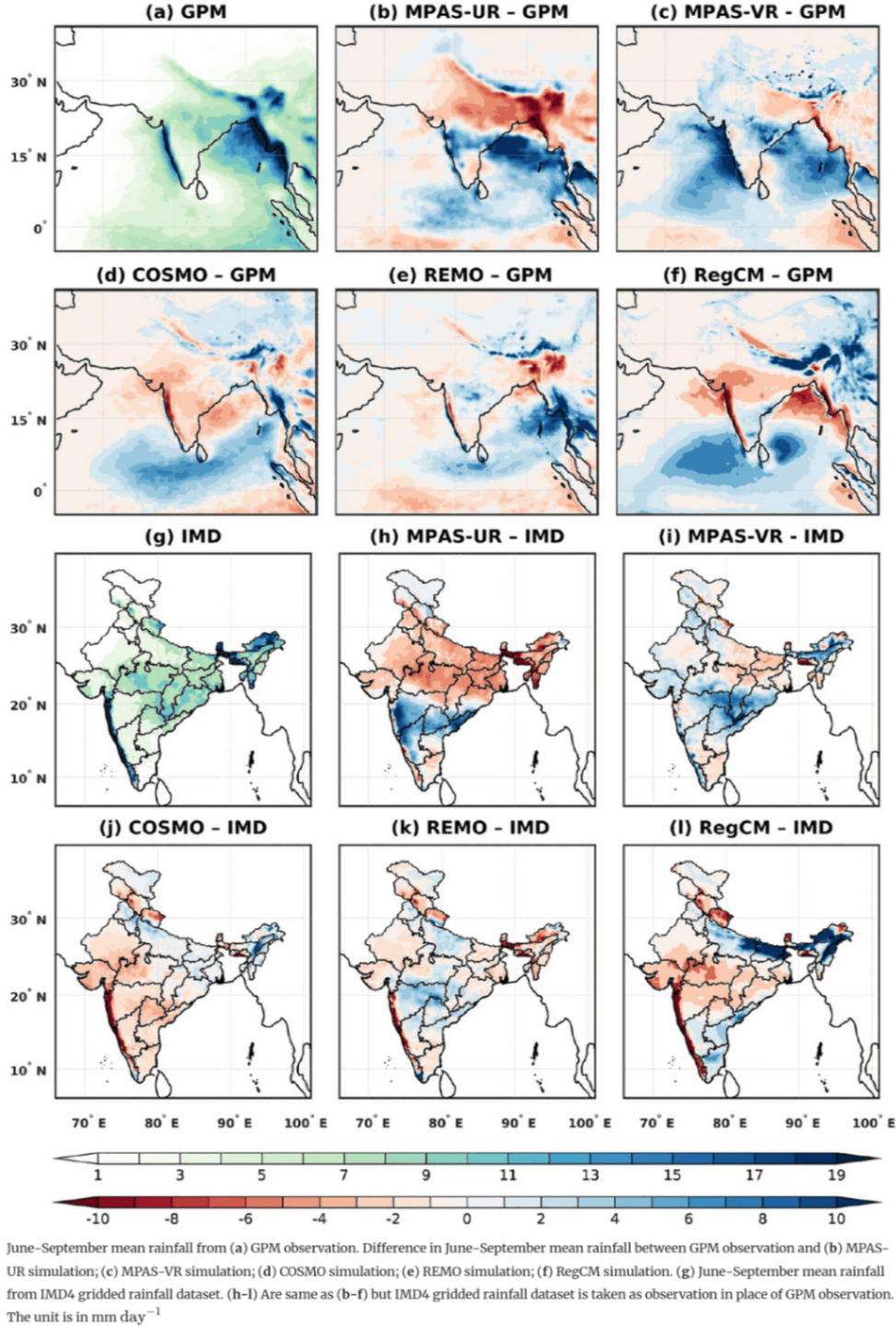
Numerous studies have demonstrated that enhancing resolution improves the performance of state-of-the-art global general circulation models (GCMs) by partially resolving some subgrid-scale processes, such as orographically-induced circulation, land-sea breeze, and the synoptic and mesoscale convective systems, which are often underrepresented at coarser resolutions. However, this enhancement requires substantial computational power. Variable-resolution (VR) meshes offer a computationally efficient alternative to uniformly high-resolution simulations, producing comparable results over the region of interest where VR is used. The Model for Prediction Across Scales (MPAS), equipped with the physical parameterizations of the Advanced Research WRF (ARW), is a fully compressible, non-hydrostatic global model with capabilities for both quasi-uniform and VR configurations. In our research, we conducted 12-year simulations of the South Asian summer monsoon season using MPAS with a 120 km quasi-uniform mesh (MPAS-UR) and a 92-25 km variable resolution mesh (MPAS-VR). Our objective is to evaluate the performance of MPAS and the impact of increasing mesh resolution on the simulation of various characteristics of the South Asian summer monsoon. Both MPAS-UR and MPAS-VR realistically simulated meteorological parameters and their variability. The simulations indicated an inherent wet bias in MPAS, especially over oceans. However, the high-resolution VR significantly reduced this bias across various variables, enhancing the model’s performance. Notably, MPAS-VR demonstrated performance comparable to high-resolution CORDEX regional models in simulating summer monsoon rainfall. Furthermore, the MPAS-VR model accurately represented the near-surface (2m) temperature patterns over oceans during ENSO and IOD years. It successfully reproduced the ENSO/IOD-Monsoon correlation, capturing lower rainfall during El Niño and negative IOD years, and higher seasonal rainfall during La Niña years. However, rainfall was underestimated during composite positive IOD years.
Journal Name: Meteorology and Atmospheric Physics
Authors: Debjit Paul and Sarvesh Dubey
Published article is available online
Faculty Associated
Prof. Sarvesh Dubey