Characteristics of Haze Pollution Events during Biomass Burning Period at an Upwind Site of Delhi
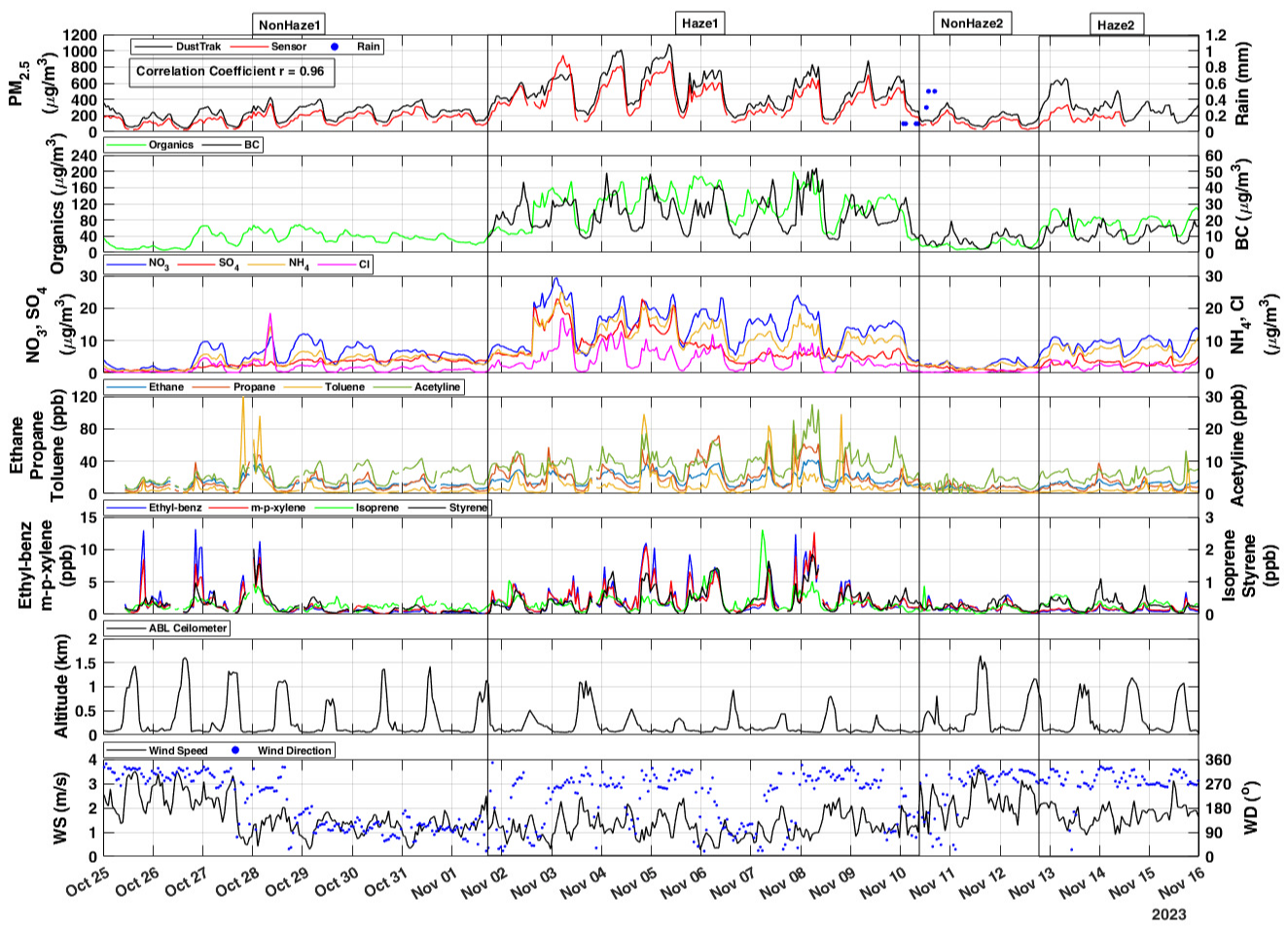
The National Capital Region (NCR) of Delhi frequently experiences severe haze episodes during the post-monsoon and winter months, driven by long-range transport of biomass burning aerosols, local emissions, and unfavorable meteorological conditions. However, observational studies tracing these pollution episodes along the pathway to Delhi are lacking. This study investigates haze pollution at an upwind site in Sonipat using advanced instrumentation during October 25 to November 15, 2023, encompassing biomass burning and Diwali events. Sudden spikes in pollutants caused severe haze, temporary reductions in pollution due to rainfall, and a resurgence of haze during Diwali. Two major haze episodes were identified, with particulate matter (PM2.5) levels exceeding 300 μg/m³. Organics dominated composition based PM2.5 (C-PM2.5) followed by Black Carbon (BC), jointly accounting for ~80% of total mass during all the episodes, with secondary inorganics contributed minimally. Limited day-night variations and low inorganics contribution suggested minimal photochemical activity and secondary formation. Elevated levels of biomass burning tracers and emission ratios indicated aged, oxidized aerosols from crop residue burning in Punjab and Haryana, supported by fire count data and 72-hour backward trajectory analysis. Regional meteorology, including a shallow atmospheric boundary layer (ABL) and low wind speeds, hindered pollutant dispersion, leading to accumulation and prolonged haze. By integrating emission analysis, meteorological factors, and transport dynamics, this study provides critical insights into haze formation, emphasizing the need for targeted mitigation strategies, such as stricter crop residue burning controls and improved emission management, to address haze pollution and its health risks effectively.
Picture Description: Time series of (a). PM2.5 from DustTrak and CUPI sensor with rainfall (b). Organics and BC (c). Inorganic fraction of PM2.5 i.e., NO3, SO4, NH4, and Cl (d and e). Different VOCs (f). ABL height derived from Ceilometer (g). Wind speed and wind direction over the study site.
Journal name – JGR: Atmospheres
Authors: Jaswant Rathore, Dilip Ganguly, Vasu Singh, Vimal Jose Vazhathara, Ravi Kumar Kunchala, Shahzad Gani, Sagnik Dey
Published article is available online
Faculty Associated
Prof. Dilip Ganguly, Prof. Ravi Kumar Kunchala, Prof. Shahzad Gani, Prof. Sagnik Dey