Investigation of the impact of complex coastline geometry on the evolution of storm surges along the eastern coast of India: a sensitivity study using a numerical model
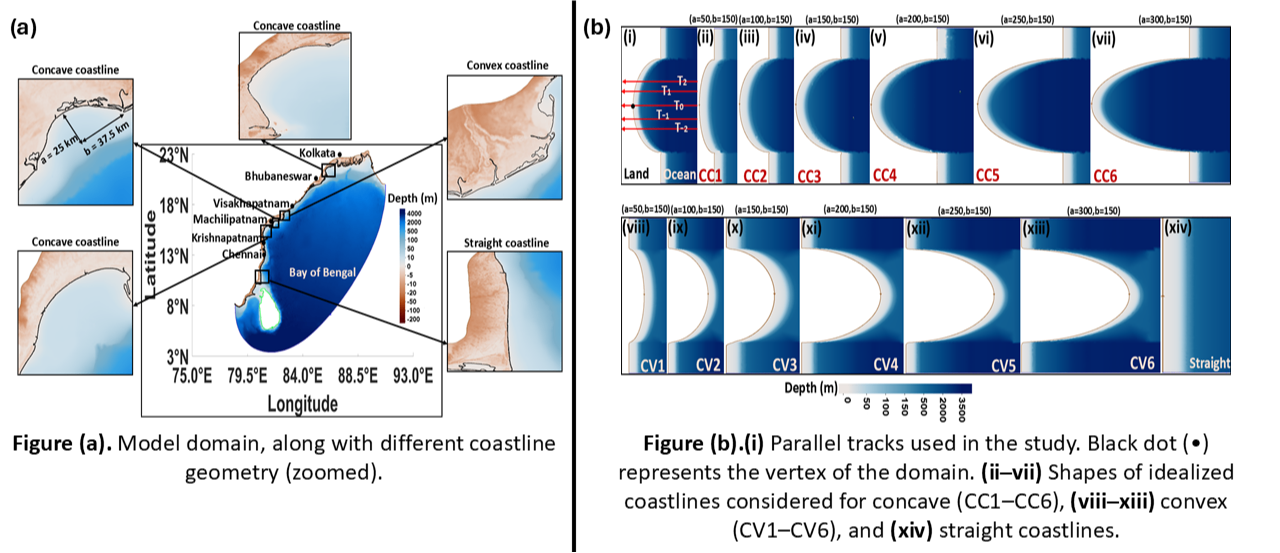
We conduct a comprehensive investigation of the generation of storm surges along the coast in response to complex coastline geometry using a standalone advanced circulation (ADCIRC) model. The study deals with sensitivity experiments using various idealized concave and/or convex model domains with the same intensity in terms of parallel cyclone tracks. It demonstrates that a sharp curvature, along with the landfall location of each track within the domain, has more influence on the surge evolution. Peak surges (PSs) are generated in the domain with tracks possessing strong onshore winds, while intense alongshore winds are responsible for PSs spreading along the coast. The time evolution of both positive and negative surges along the coast is also demonstrated. The propagation of energy density per unit length associated with surge waves is computed for concave coasts to explain the funneling effect. Using parallel tracks, the development of PSs is also seen, with actual intricate coastal stretch having concave and convex coastlines along the eastern coast of India, which is consistent with the findings of idealized experiments. Further simulations are carried out along real coastlines, with the different approach angles of the track exhibiting that maximum PSs are not always aligned with the east of the track. Depending on the track angle, PSs may also develop on the western side. Experiments on real coastlines also indicate that peak surge in the concave coastline is more influenced by the cyclone's radius of maximum winds. Surge generation with different radii of maximum winds is seen to the western side of the track, though the cyclone does not experience landfall in this region. Simulation with a recent cyclone, Michaung, reveals that the occurrence of storm tides is also seen to the west of the landfall location as the track moves parallel to the coast, which agrees with the observations. This study shows the importance of the local coastline configuration, particularly for the concave coasts, in relation to the intensification of storm surges.
Journal name – EGU Ocean Science.
Authors: Pawan Tiwari, A D Rao, Smita Pandey, and Vimlesh Pant.
Published article is available online
Faculty Associated
Prof. A D Rao and Prof. Vimlesh Pant.