Exploring the influence of physical and chemical factors on new particle formation in a polluted megacity
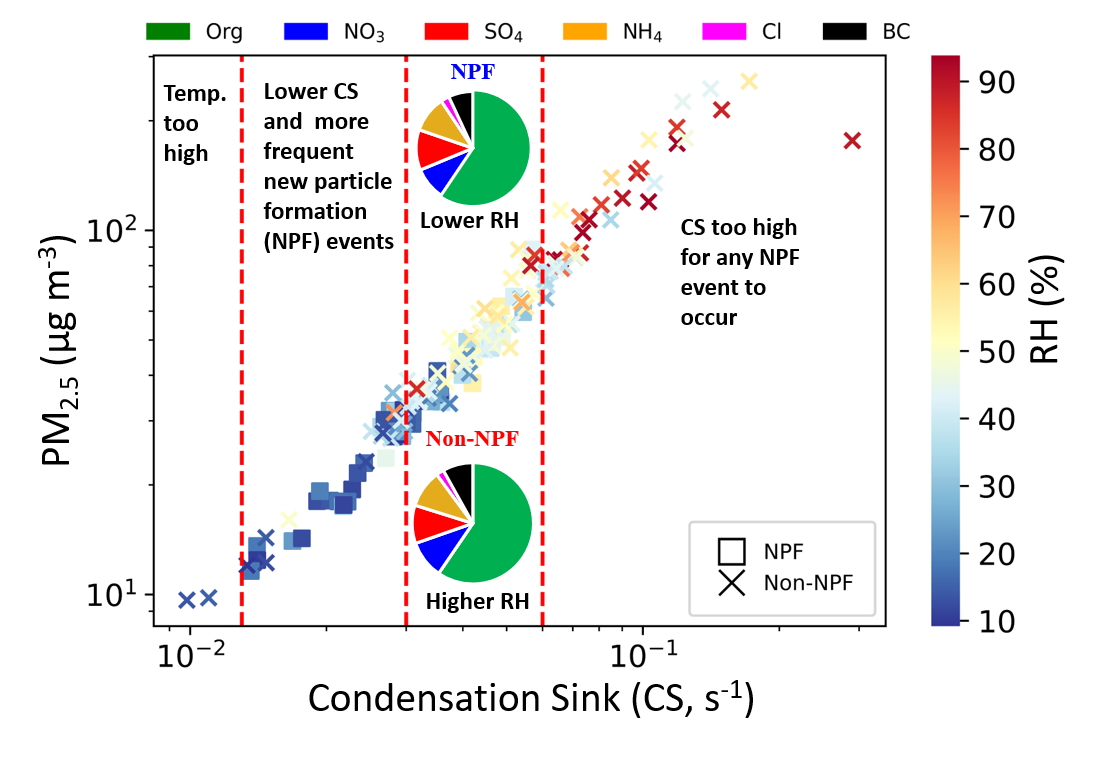
New Particle Formation (NPF) is typically suppressed in polluted urban environments due to the high concentrations of preexisting particles, which act as a condensation sink (CS) for gaseous precursors. However, NPF events are still observed in places such as Delhi. In this study, we combined one year of particle number size distributions and PM2.5 chemical composition data to explore the factors influencing NPF in Delhi. Although some studies propose that the chemical composition of particles affects the CS by altering particle hygroscopicity and the contact angle, our findings suggest that chemical composition was not a significant factor. Instead, we found that variations in relative humidity (RH) influenced aerosol liquid water content (ALWC), which played a crucial role in either promoting or inhibiting NPF events. This highlights the variability among different polluted environments, where meteorological conditions, particularly RH, can significantly influence the occurrence of NPF events.
Journal: Environmental Science: Atmospheres
Authors: Umer Ali, Vikram Singh, Mohd Faisal, Mayank Kumar, Shahzad Gani
Published article is available online
Faculty Associated
Prof. Shahzad Gani