Assessing the Influence of Land Use and Land Cover Data on Cyclonic Winds and Coastal Inundation due to Tropical Cyclones: A Case Study for the East Coast of India
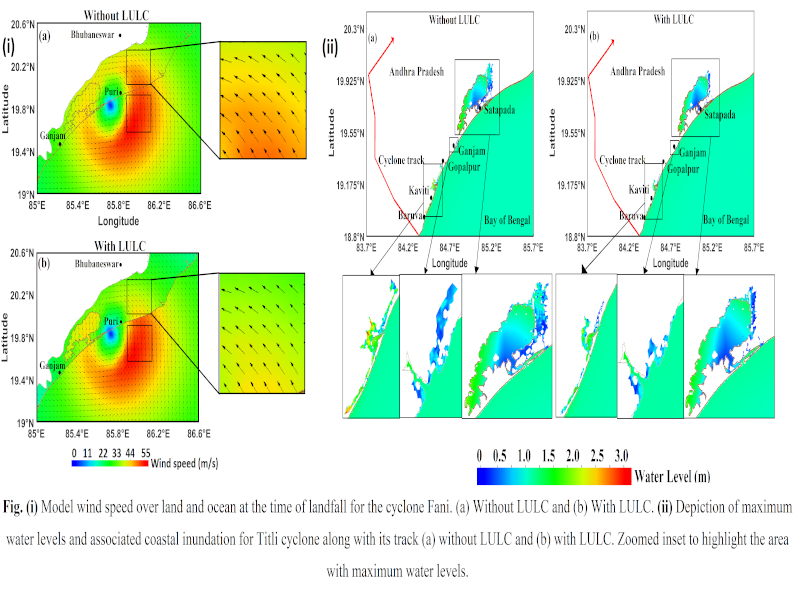
A standalone Advanced Circulation (ADCIRC) model for the east coast of India with a high-resolution grid of 100m near the coast is used to evaluate coastal inundation resulting from the storm tides generated by recent cyclones. A directional surface roughness parametrization that alters wind speed and Manning's n friction coefficient to compute bottom friction based on land use/land cover (LULC) at a particular location is incorporated in the model. ERA5 reanalysis winds highlight that the cyclonic winds over the land are less intensive than nearby coastal oceans, particularly during landfall time, by approximately 29% - 50%. Experiments are also designed to quantify the impact of surface and bottom friction on wind speed and the inward propagation of storm tides. A comparison of cyclonic wind speed after incorporating LULC data in the model is made with an automatic surface observation system (ASOS). It suggests a 15–29% reduction, consistent with ASOS. The inundated area computed for the cyclones advocates a significant reduction (15–50%) due to LULC. Sensitivity experiments with LULC are performed to examine the impact of mangroves in the Krishna estuary located in between two concave-shaped coastal geometries. Replacing wetlands with Mangroves results in a simultaneous decline in wind speed (12.5%) and inundated area (13.4%). It also highlights that bottom friction contributes (9.4%) in the inundated area against surface friction (4%). This study infers that further investigation and planning are mandatory to ensure coastal mangrove restoration initiatives and effective coastal management practices.
Journal name - Natural Hazards
Pawan Tiwari, A D Rao, Smita Pandey, and Vimlesh Pant
Published article is available online
Faculty Associated
Prof. A D Rao and Prof. Vimlesh Pant