Chemical characterization and source apportionment of carbonaceous aerosols during post-monsoon biomass burning and Diwali at an upwind site of Delhi
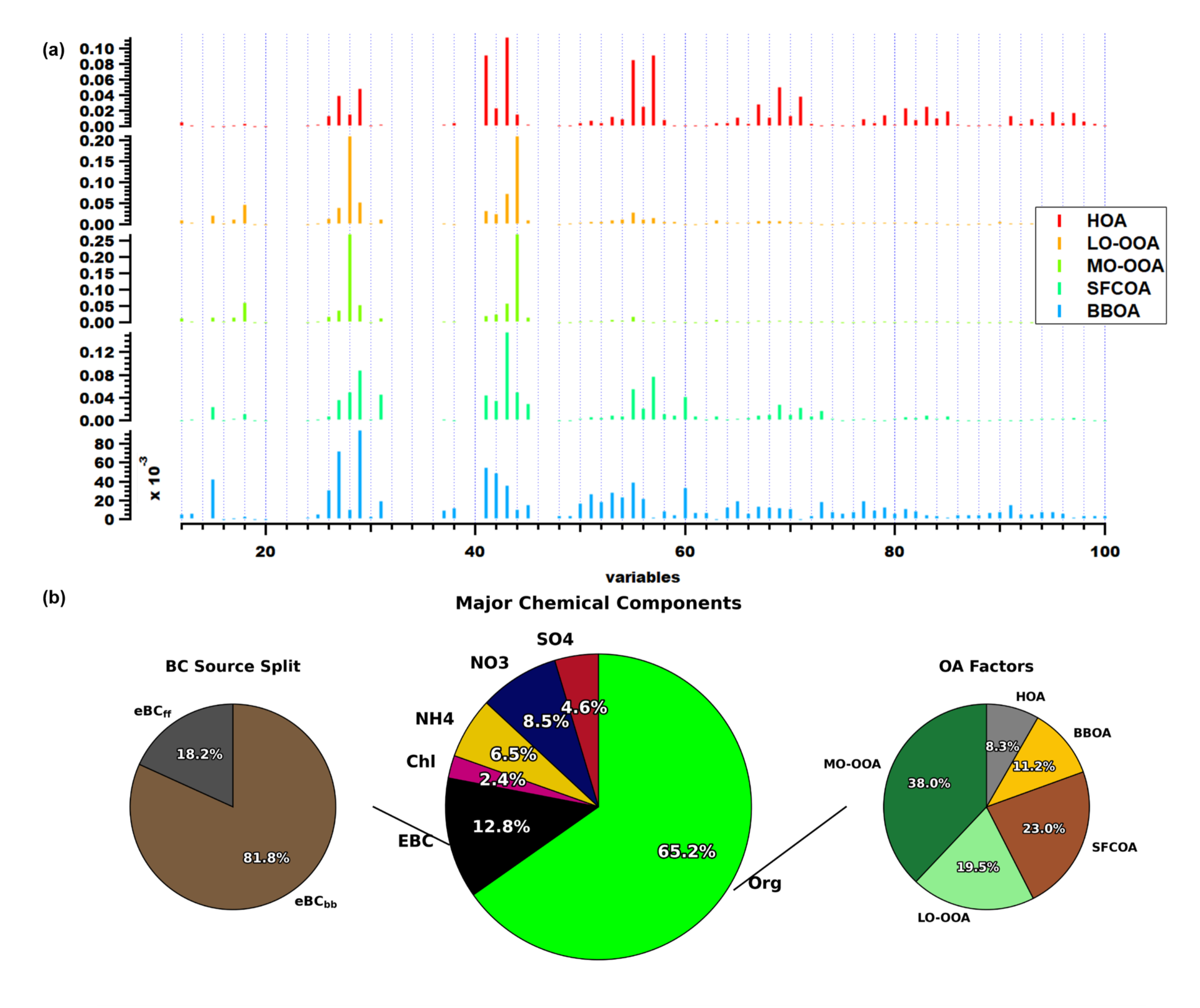
Title: Chemical characterization and source apportionment of carbonaceous aerosols during post-monsoon biomass burning and Diwali at an upwind site of Delhi Authors: Vasu Singh, Dilip Ganguly, Jaswant Rathore, Lokesh Kumar Sahu, Ravi Kumar Kunchala, and Sagnik Dey Journal name: Atmospheric Chemistry and Physics Abstract: Severe post-monsoon haze in Delhi-NCR poses air-quality and health risks and reflects regional and urban emissions. Sonipat lies along the principal transport corridor linking the agricultural burning regions of Punjab and Haryana with Delhi and serves as an intermediate receptor for regional pollution. However, source apportionment at upwind locations remains limited. To address this gap, we measured composition-based PM2.5, defined as non-refractory PM2.5 plus equivalent black carbon, at Sonipat from 25 October to 15 November 2023 using a Time-of-Flight Aerosol Chemical Speciation Monitor and a multi-wavelength Aethalometer. Positive matrix factorization, black-carbon apportionment, and trajectory and wind analyses were used to identify carbonaceous aerosol sources and examine their evolution during haze, non-haze, and Diwali periods. Two severe haze episodes occurred, with composition-based PM2.5 exceeding 300 µg m-³. Organic aerosol contributed 65% of non-refractory PM2.5, and its daily mean reached nearly 140 µg m-³. Oxygenated organic aerosol accounted for approximately 57-60% of total organic aerosol, with more-oxidized oxygenated organic aerosol reaching 42.8 µg m-³ during peak haze, indicating substantial secondary processing and accumulation. Under the reference absorption Ångström exponent pair, biomass- or solid-fuel-related eBC accounted for approximately 78% of the campaign-integrated eBC burden, although the quantitative source split was sensitive to the assumed exponents. Northwestern transport signatures and co-variation of eBCbb with biomass-burning and solid-fuel organic aerosol indicate an important regional combustion influence. These findings show that carbonaceous aerosol was already present at this receptor before further interaction with Delhi emissions and support coordinated regional controls alongside sustained urban emission reductions. |