High-resolution numerical modelling of seasonal volume, freshwater, and heat transport along the Indian coast
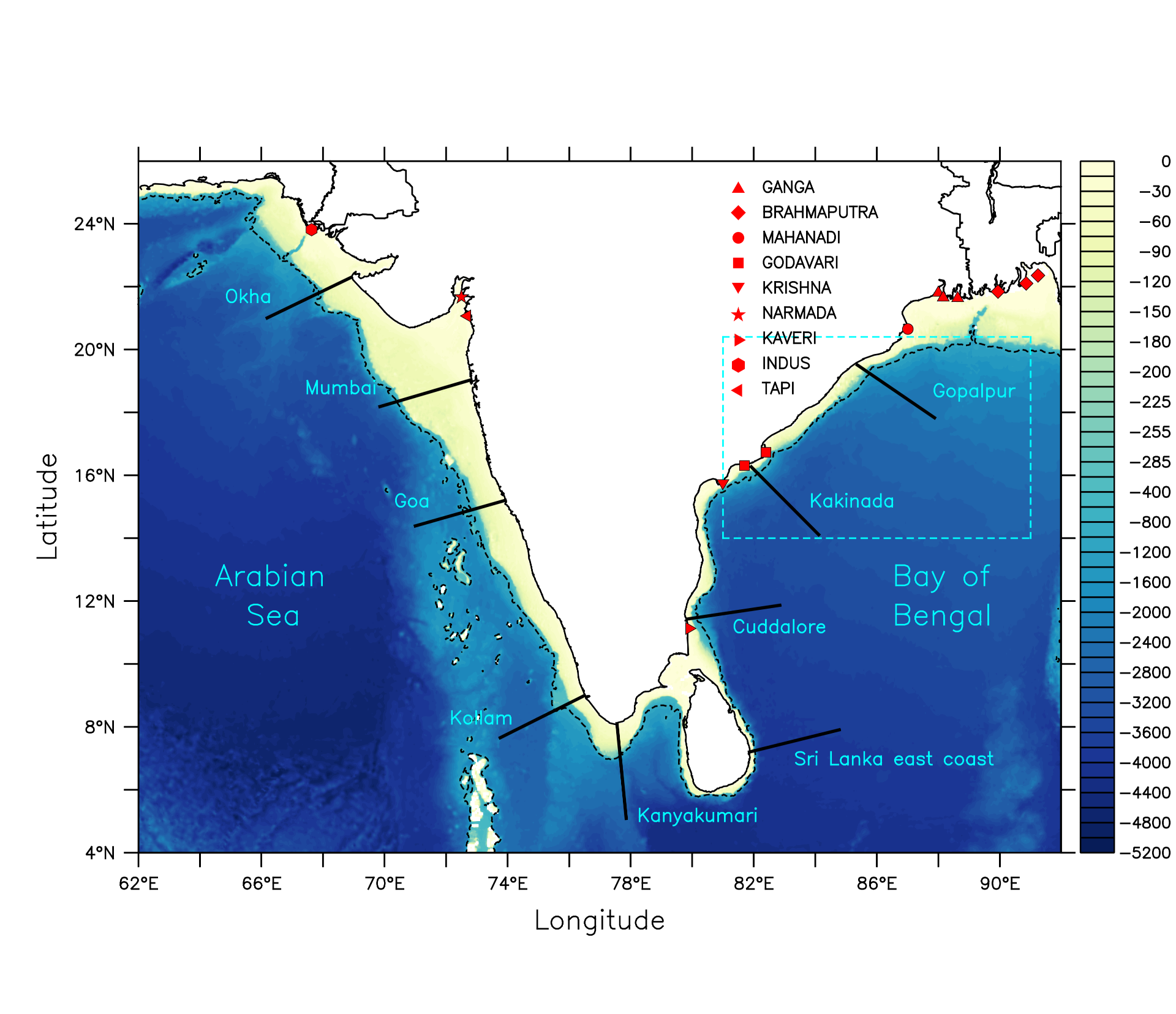
Seasonal reversal of winds and equatorial remote forcing influences the circulation of the Arabian Sea (AS) and Bay of Bengal (BoB) basins in the northern Indian Ocean. In this study, we numerically modelled the physical characteristics of the AS and BoB, using the Massachusetts Institute of Technology general circulation model (MITgcm) at a high spatial resolution of 1/20° forced with climatological initial and boundary conditions. The simulated temperature, salinity, and flow fields were validated with satellite and in situ datasets. We then studied the exchange of coastal waters by evaluating transports computed from the model simulations. The alongshore volume transport on the eastern coast is stronger with high seasonal variability due to the poleward-flowing western boundary current and equatorward-flowing East Indian Coastal Current. West coast transport is influenced by large intraseasonal oscillations. The alongshore freshwater transport is an order less than the alongshore volume transport. Out of the net volume transport, freshwater accounts for a maximum of 6.03 % during the southwestern monsoon season, followed by 4.85 % in the post-monsoon season. We observe an inverse relationship between alongshore freshwater and volume transport on the western coast and a direct relationship on the eastern coast. The contribution of eddy-induced heat and freshwater transport was also examined. The relation between net heat transport and net heat flux illustrates the role of coastal currents and equatorial forcing in dissipating heat within the coastal waters. We observed that meridional heat transport over the AS is stronger than over the BoB. Both basins act as a heat source during the summer monsoon and heat sink during the winter. This high-resolution model setup simulates all the important physical climatological patterns, leading to a better understanding of the state of the northern Indian Ocean.
Journal: Ocean Science
Authors: Kunal Madkaiker, A. D. Rao, and Sudheer Joseph
Published article is available online
Faculty Associated
Prof. A D Rao