Interannual variability of coastal upwelling features along the eastern and western margins of the Arabian Sea
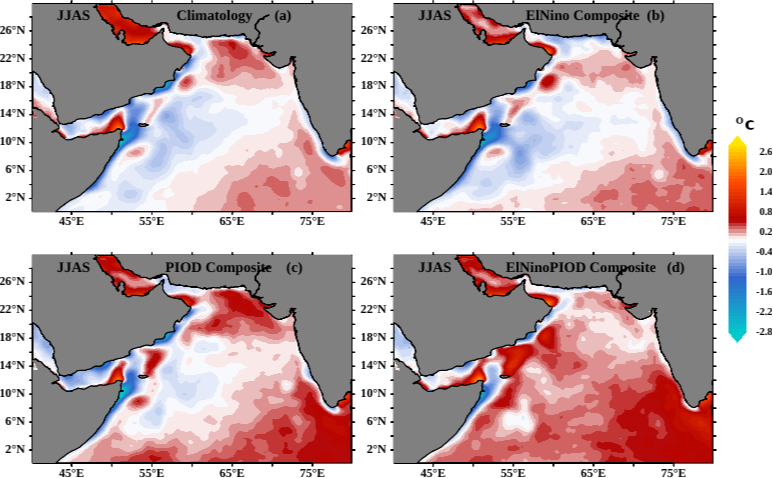
The Arabian Sea (AS), a basin in the North Indian Ocean (NIO), possesses strong coastal upwelling in its eastern and western margins. The spatio-temporal variability of upwelling over the Somalia, Oman and southwest coast of India is analyzed using observed data sets. The spectral analysis of upwelling indices highlight that the semi-annual and annual frequencies were dominant by two orders of magnitude compared with the inter-annual variability over these upwelling zones. The inter-annual variability of coastal upwelling was demarcated with variations in the causative forcing of upwelling associated with the positive modes of Indian Ocean Dipole (pIOD), El-Niño Southern Oscillation (El-Niño) and combined pIOD and El-Niño events over the southwest coast of India (SWCI) and Somalia. Along SWCI, the sea surface temperature and meridional wind stress weakened leading to warming associated with the suppression of upwelling during El-Niño, pIOD and combined events. Along Somalia, the upwelling favorable wind stress showed slight weakening due to pIOD and strong decline due to both El-Niño and combined modes. Along Oman, the upwelling favorable wind stress indicated negligible changes due to pIOD, increase due to El-Niño, and slight decline due to combined modes.
Fig: The JJAS SST anomaly (°C) composites for all years 1995-2018 (a), and for three types of events El-Niño (2002, 2004, 2009) (b), pIOD (2003, 2007, 2008, 2012) (c), combined El-Niño and pIOD modes (1997, 2006, 2015) (d). The anomalies were calculated with respect to the climatology of 1995-2018 and climate indices were calculated with respect to climatology of 1982-2020.
Tanuja Nigam & Vimlesh Pant
Published article is available online
Faculty Associated
Prof. Vimlesh Pant