Modelling ambient PM2.5 exposure at an ultra-high resolution and associated health burden in megacity Delhi: exposure reduction target for 2030
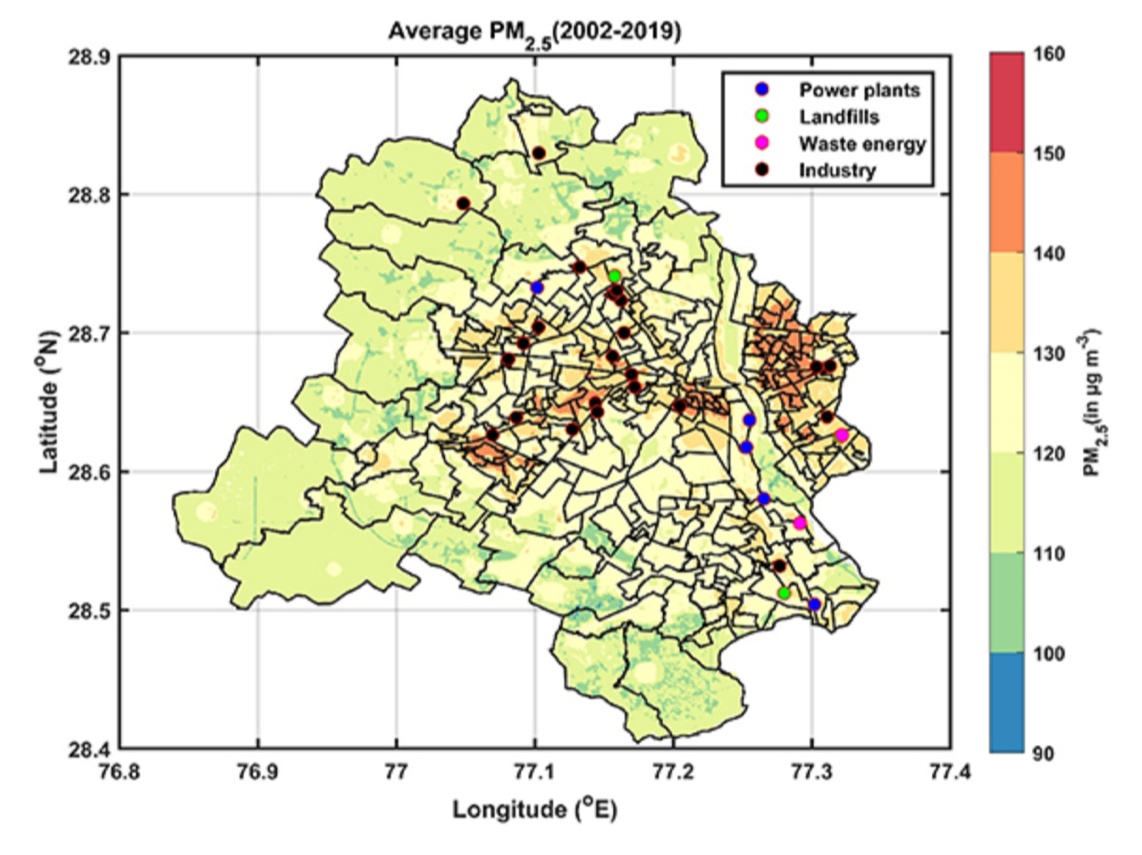
Deriving hyperlocal information about fine particulate matter (PM2.5) is critical for quantifying exposure disparities and managing air quality at neighborhood scales in cities. Delhi is one of the most polluted megacities in the world, where ground-based monitoring was limited before 2017. Here we estimate ambient PM2.5 exposure at 100 m × 100 m spatial resolution for the period 2002–2019 using the random forest model. The model-predicted daily and annual PM2.5 show a ten-fold cross-validation R2 of 0.91 and 0.95 and root mean square error of 19.3 and 9.7 μg m−3, respectively, against coincident ground measurements from the Central Pollution Control Board ground network. Annual mean PM2.5 exposure varied in the range of 90–160 μg m−3 in Delhi, with shifts in local hotspots and a reduction in spatial heterogeneity over the years. Mortality burden attributable to ambient PM2.5 in Delhi increased by 49.7% from 9188 (95% uncertainty interval, UI: 6241–12 161) in 2002 to 13,752 (10,065–19,899) in 2019, out of which only 16% contribution was due to the rise in PM2.5 exposure. The mortality burden in 2002 and 2019 are found to be higher by 10% and 3.1%, respectively, for exposure assessment at 100 m scale relative to the estimates with 1 km scale. The proportion of diseases in excess mortality attributable to ambient PM2.5 exposure remained similar over the years. Delhi can meet the United Nations Sustainable Development Goal 3.4 target of reducing the non-communicable disease burden attributable to PM2.5 by one-third in 2030 relative to 2015 by reducing ambient PM2.5 exposure below the World Health Organization’s first interim target of 35 μg m−3. Our results demonstrate that machine learning can be a useful tool in exposure modelling and air quality management at a hyperlocal scale in cities.
Shashi Tiwari, Alok Kumar, Supriya Mantri and Sagnik Dey
Published article is available online
Faculty Associated
Prof Sagnik Dey