Ion and particle size distribution measurements in the Indo-Gangetic Plain: seasonal insights and challenges in new particle formation event characterization
Title: Ion and particle size distribution measurements in the Indo-Gangetic Plain: seasonal insights and challenges in new particle formation event characterization
Journal: Atmospheric Chemistry and Physics, 26, 14917–14938, 2026
Authors: Gaurav Kumar Srivastav, Aasif Ahmad Wagay, Janne Lampilahti, Jaswant Rathore, Ravi Kumar Kunchala, Dilip Ganguly, Markku Kulmala, Tuukka Petäjä, Pauli Paasonen, Roseline C. Thakur, Shahzad Gani
Link: https://doi.org/10.5194/acp-26-14917-2026
Faculty associated: Prof. Shahzad Gani, Prof. Dilip Ganguly, Prof. Ravi Kumar Kunchala
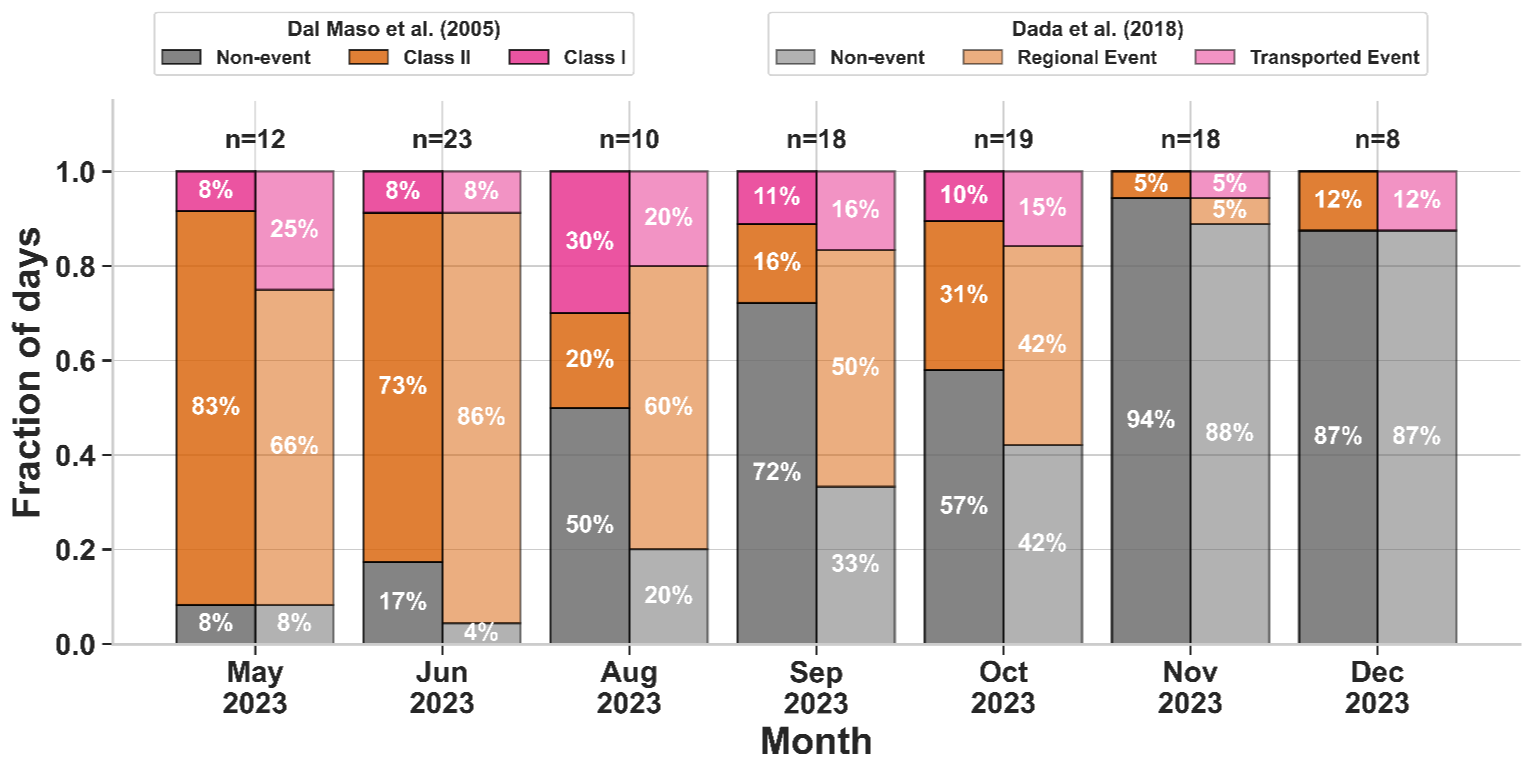
Summary: New particle formation (NPF) is a major source of atmospheric aerosols and cloud condensation nuclei, but it is hard to study in the Indo-Gangetic Plain. High particle concentrations and pollution plumes from nearby sources can hide particle formation and growth, or even be mistaken for them. Using ion (0.8–42 nm) and particle (2.5–42 nm) measurements from the CAS Atmospheric Observatory at IIT Delhi's Sonipat campus (May–December 2023), we found that NPF was most active in summer, occurring on 30 of 35 days in May–June (86 %), when event mornings generally had a lower condensation sink. After the monsoon, events were less frequent (20 of 73 days, 28 %) and harder to classify. Comparing three classification methods showed that the absence of a visible particle growth band does not necessarily mean that NPF has not occurred. These results raise a broader question: how well do methods developed for cleaner places work in highly polluted environments? The data and the Python code used in the analysis are openly available.